
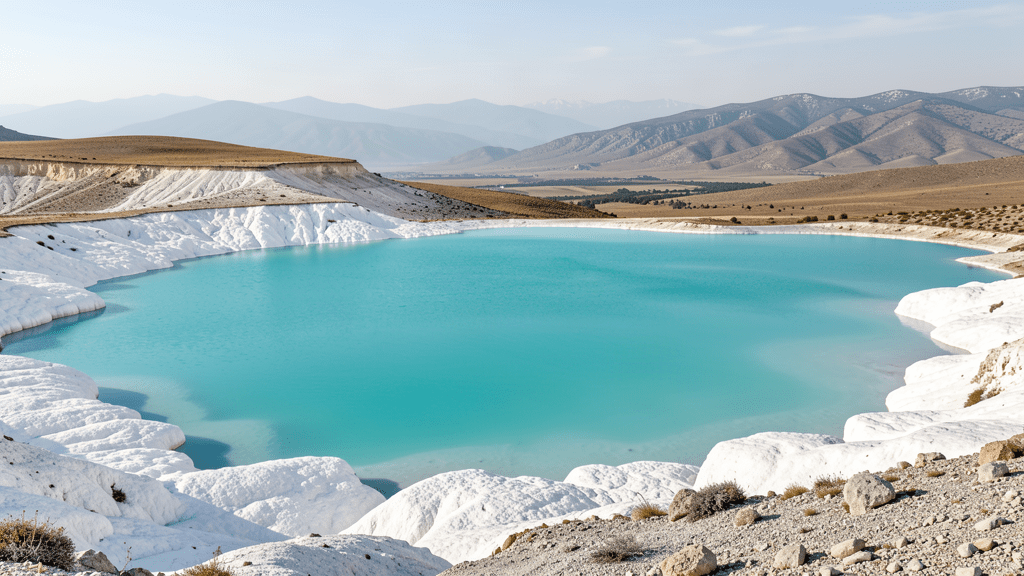
Why is Lake Salda turquoise?
Lake Salda’s vivid turquoise water is the result of a strong light contrast between its highly alkaline, magnesium-rich water and the white carbonate structures along its shore. Behind the picture-postcard scene lies a working geology: ultramafic rocks in the catchment, the mineral hydromagnesite, and microbial life all cooperate to build the landscape.
What kind of lake is Salda?
Lake Salda is in the Yeşilova district of Burdur, in a closed basin with no outlet to the sea. Official records describe a surface area of roughly 44 square kilometres and a maximum depth of 184 metres, with strongly alkaline water. Because the basin does not drain, dissolved material carried in by rain and groundwater accumulates rather than leaving the system, which sharpens the lake’s chemistry over time.
The lesson from the catchment is simple: the lake is not just a body of water. Rain and groundwater react with surrounding rocks, magnesium-rich components are carried into the lake, and the chemistry of the water sets the conditions in which carbonate structures can grow at the shore.
What makes the shores white?
The pale shore formations are built mainly around a hydrated magnesium carbonate called hydromagnesite, which is a major component of the lake’s microbialites. Calling them ‘white sand’ misses the point: much of the pale material near the waterline is an organo-sedimentary deposit produced by mineral precipitation and microbial activity, not eroded rock fragments.
These structures are not the same as Pamukkale’s travertine terraces. Hot spring water deposits calcium carbonate to build Pamukkale, whereas Salda’s pale structures grow from magnesium-rich alkaline lake conditions and microbial carbonate formation. The two landscapes look similar in their whiteness but form through different water–rock interactions.
What are microbialites?
Microbialites are carbonate organo-sedimentary structures built by, or shaped by, the activity of microorganisms. Stromatolites, thrombolites and stromatolitic–thrombolitic forms have all been recorded in Salda, and their appearance varies with water depth, sediment movement and the composition of the microbial community. A 2025 study in the Turkish Journal of Geology also identified dypingite, a second hydrated magnesium carbonate, alongside hydromagnesite in Salda’s microbialites.
Why does Salda matter for Mars research?
Salda has attracted attention as a terrestrial analogue for Mars’s Jezero Crater, not because the two environments are alike, but because its magnesium-rich carbonates, microbialites and sedimentary structures let scientists compare how an ancient lake’s mineral record and possible biosignatures might form. The value is not proof of past life; it is in separating which biological or non-biological processes can produce similar mineral and sedimentary structures.
Lake Salda and its surroundings were declared a Special Environmental Protection Area by presidential decree on 14 March 2019, covering roughly 295.63 square kilometres. The need for protection is not only about keeping the view intact — the shoreline, water and catchment rocks are one system, and tread damage or sediment disturbance can break the very conditions that build the pale structures.