
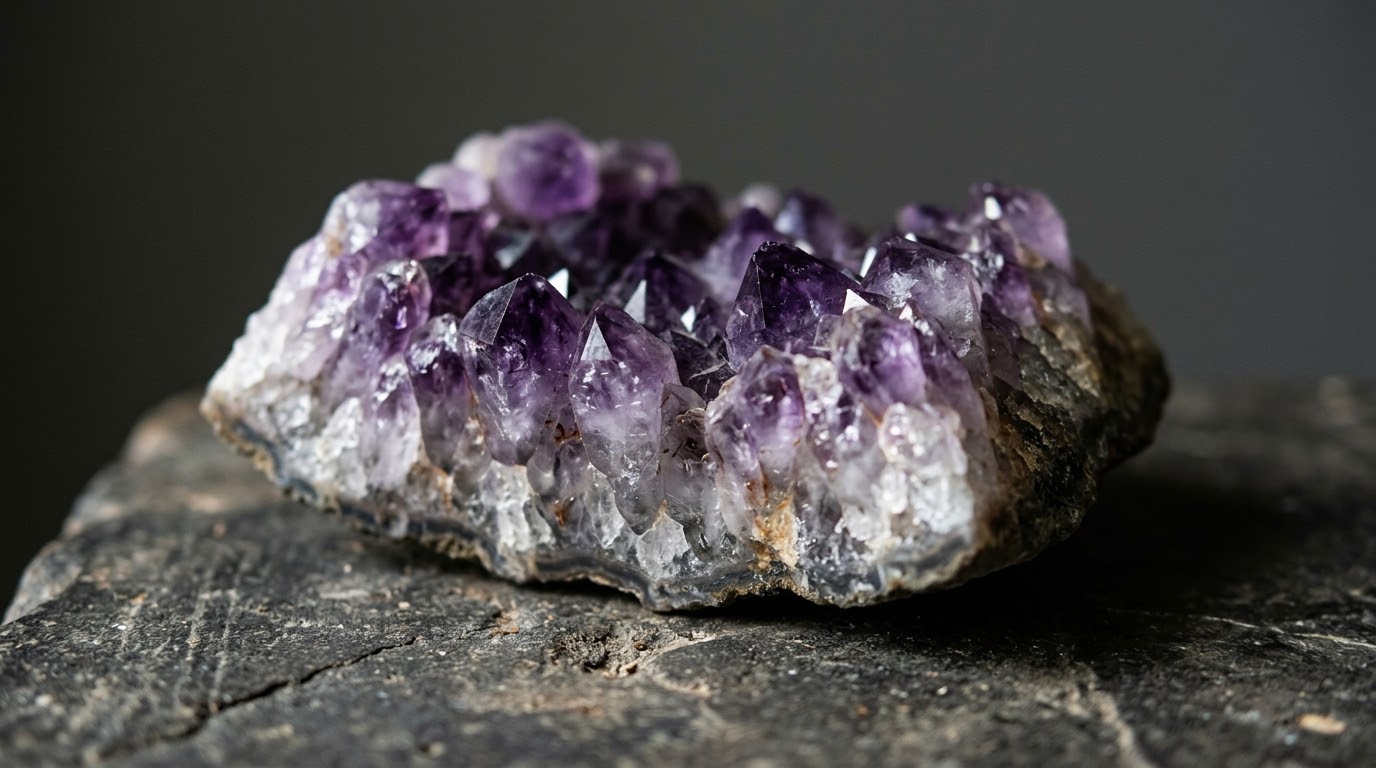
Amethyst is the violet variety of quartz. Chemically it is ordinary quartz (SiO₂); its colour comes from a trace of iron in the crystal, switched on over millions of years by natural radiation from the surrounding rock. With a hardness of 7 on the Mohs scale it wears well in jewellery, and it is the most widely sold purple gemstone. Its name comes from the Greek amethystos, “not drunk”.
Below you will find what gives amethyst its colour, where it forms (including in Scotland and Cornwall), why heated amethyst turns into citrine, and how to tell a natural stone from glass or a lab-grown one.
Why Is Amethyst Purple?
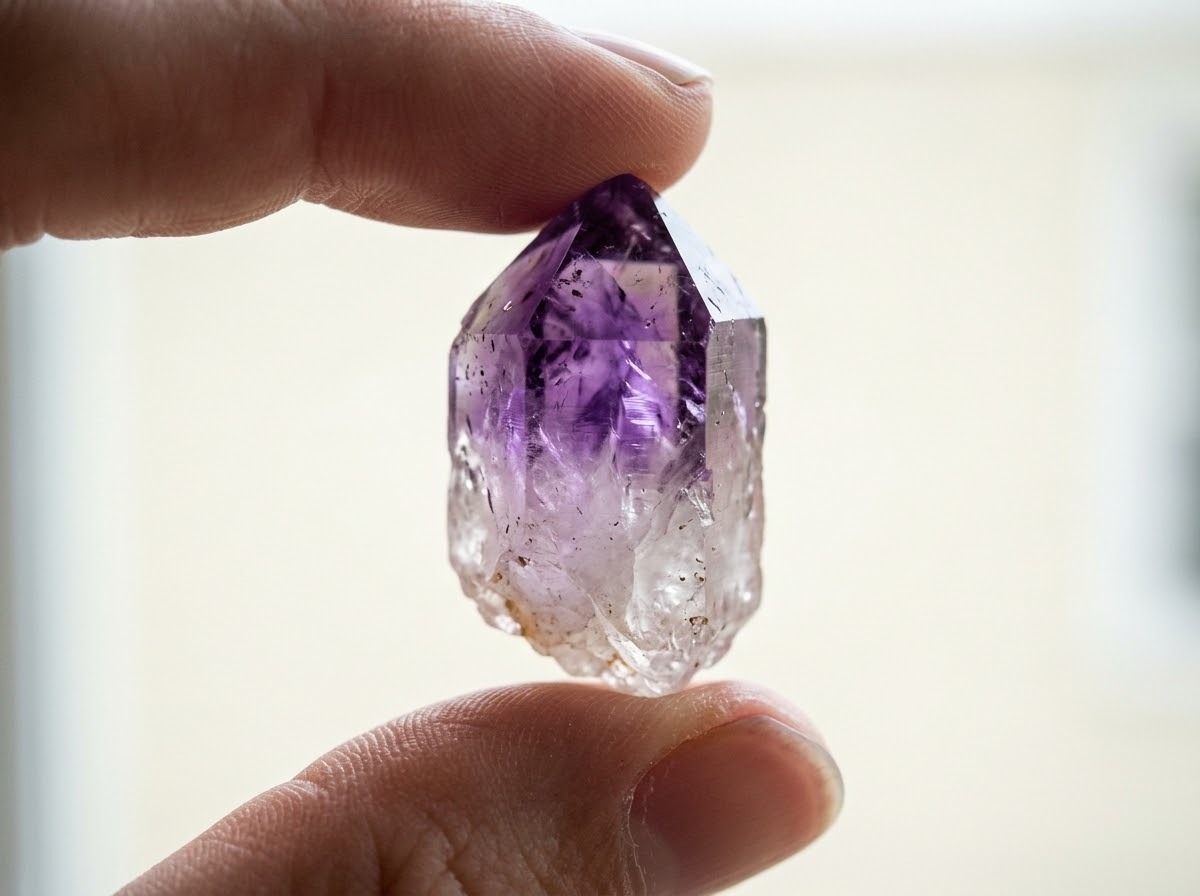
The violet is not a dye and not another mineral mixed in. As the crystal grows, a tiny amount of trivalent iron (Fe³⁺) takes the place of silicon in the quartz structure. Iron alone does not make the stone purple: natural radiation from nearby rocks slowly turns those iron sites into “colour centres” that absorb part of the light, and what reaches your eye is violet. The colour is stable, but not indestructible. Strong heat and long exposure to intense light can break those centres down.
The colour is rarely even. A crystal point is often deep purple at the tip and pale, or almost clear, at the base, and cut stones show lighter and darker bands. That patchiness is one of the easiest signs of a natural stone.
Where Does Amethyst Form?
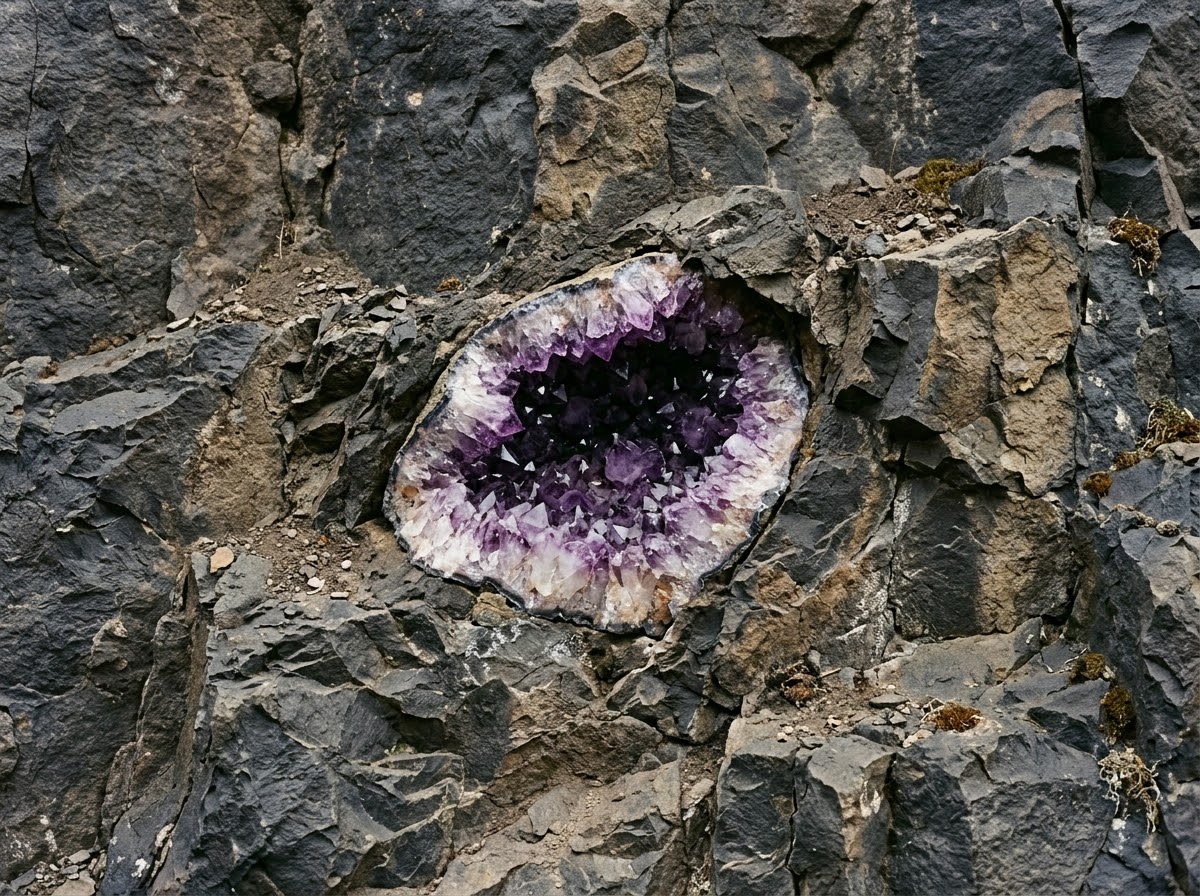
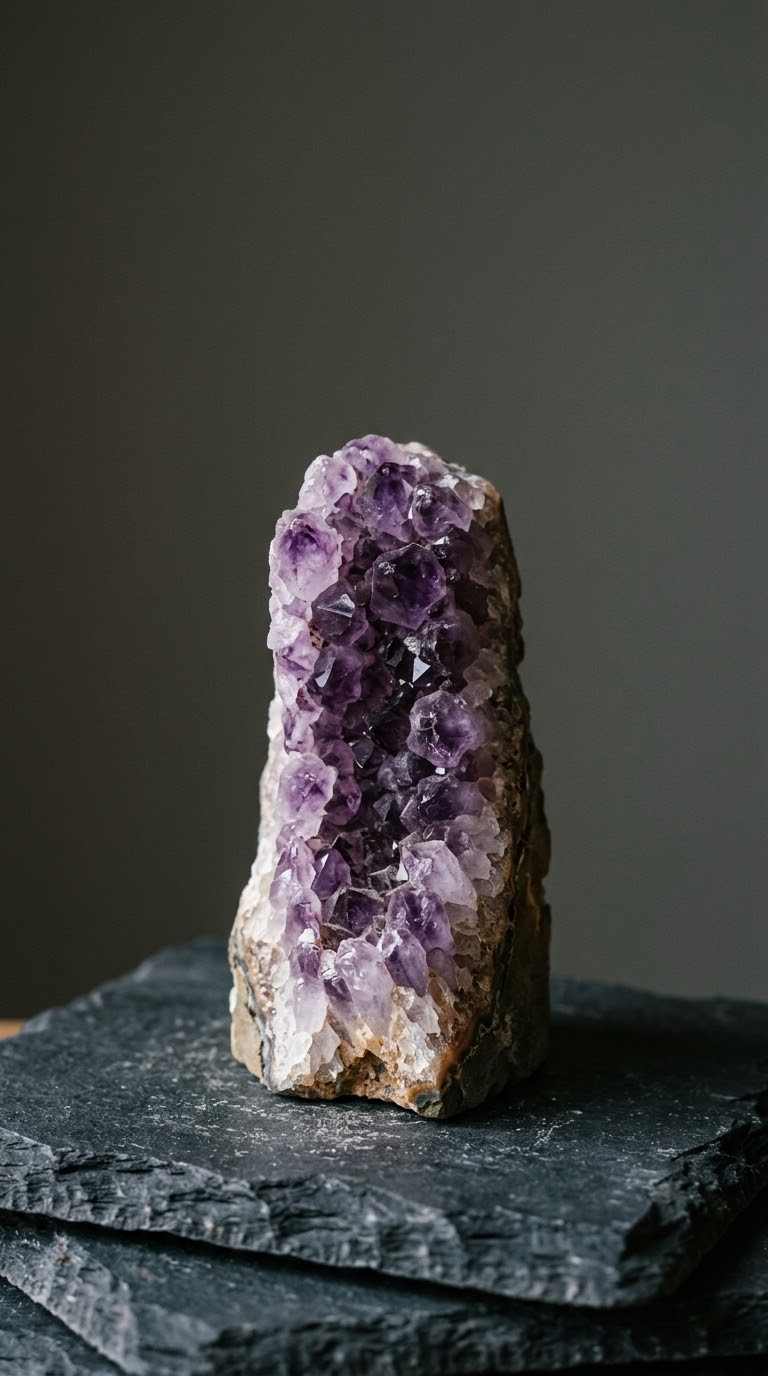
Amethyst grows in two main settings. The first is gas cavities in volcanic rock: hot, silica-rich water later fills the holes left in cooling lava and lines their walls with crystals, producing geodes that look like plain stones outside and glitter violet inside. The second is veins, where crystals settle out of hot fluids moving through cracks in the rock.
Most commercial amethyst comes from basalt geodes in southern Brazil and Uruguay and from deposits in Zambia. The giant geodes taller than a person that turn up in shops and museums come mainly from Brazil’s Rio Grande do Sul and neighbouring Uruguay.
Is there amethyst in the UK?
Yes, though Britain has never been an important source of gem-quality material. In Scotland, amethyst is recorded at Binn Hill near Glenfarg in the Ochil Hills, the remains of an ancient volcano better known to collectors for its agates, and at a handful of other sites. In Cornwall it occurs in a number of mines and veins, usually as white and purple banded masses rather than as fine crystals. Most amethyst sold in Britain is imported.
Amethyst Properties at a Glance
Amethyst is not a separate mineral but a variety of quartz, so its physical properties are those of quartz; only the colour differs.
| Property | Value |
|---|---|
| Mineral | Quartz (violet variety) |
| Chemical formula | SiO₂ (silicon dioxide) |
| Cause of colour | Trace iron (Fe³⁺) plus natural radiation |
| Crystal system | Trigonal |
| Hardness (Mohs) | 7 |
| Specific gravity | 2.65 |
| Refractive index | 1.544 – 1.553 |
| Colour | Pale lilac to deep purple, often unevenly spread |
| Sensitivity | High heat and prolonged strong light can lighten the colour |
For the structure of quartz itself and its other coloured varieties, see What Is Quartz? Properties, Varieties and Its Link with Gold.
Heated Amethyst Becomes Citrine
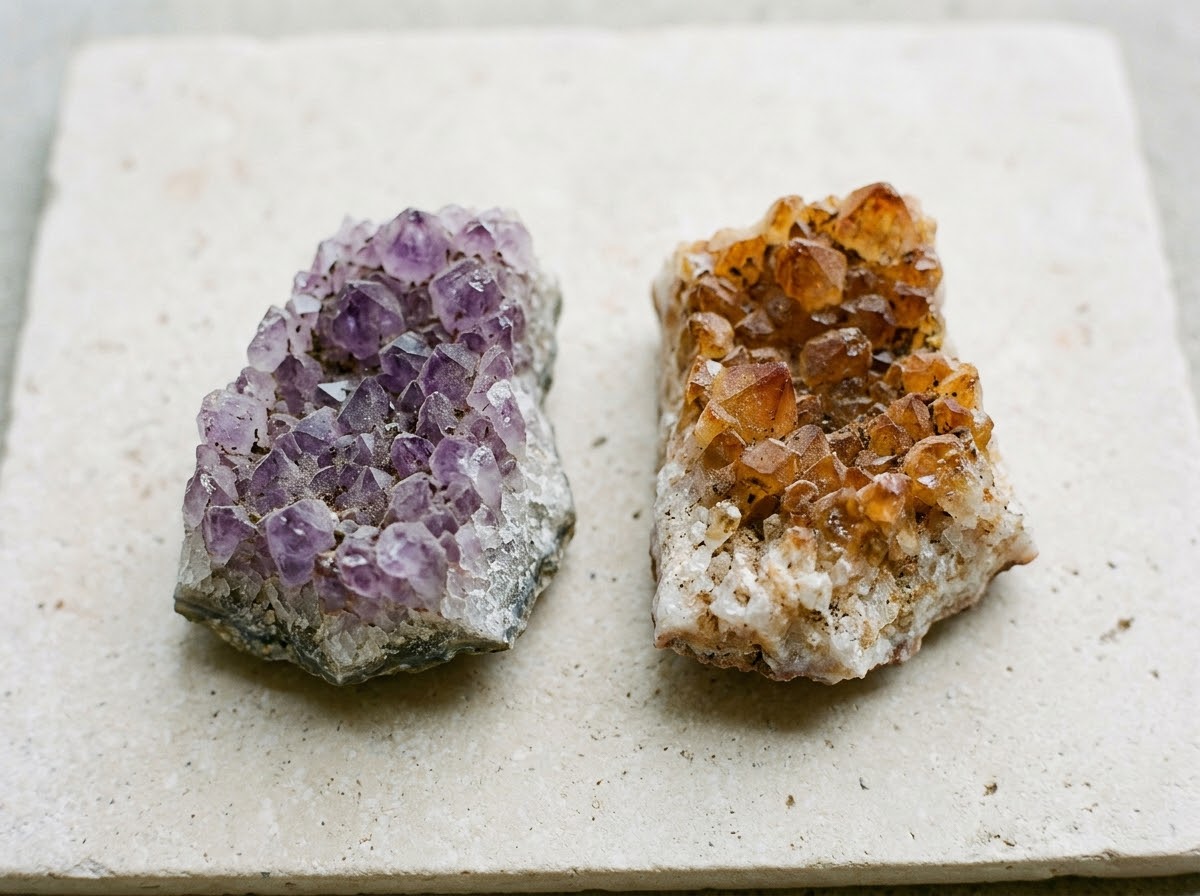
Heat changes amethyst’s colour. A 2020 study in Scientific Reports found that the stone stays purple below about 420 °C, passes through transitional shades between roughly 420 and 440 °C, and turns yellow to orange above about 440 °C, with around 560 °C given as a suitable temperature for producing citrine. A stone turned yellow this way usually cannot be brought back to purple, even by irradiation.
Much of the citrine on the market is generally accepted to be heated amethyst. Heated clusters tend to have deep orange tips and a whitish base, while natural citrine is usually a paler yellow. If you are buying citrine, asking whether it has been heat-treated is the simplest way to judge the price.
The brown-grey member of the family owes its colour to a similar natural-radiation mechanism: Smoky Quartz: Where Its Colour Comes From and How to Tell the Natural Stone.
How to Tell if Amethyst Is Real
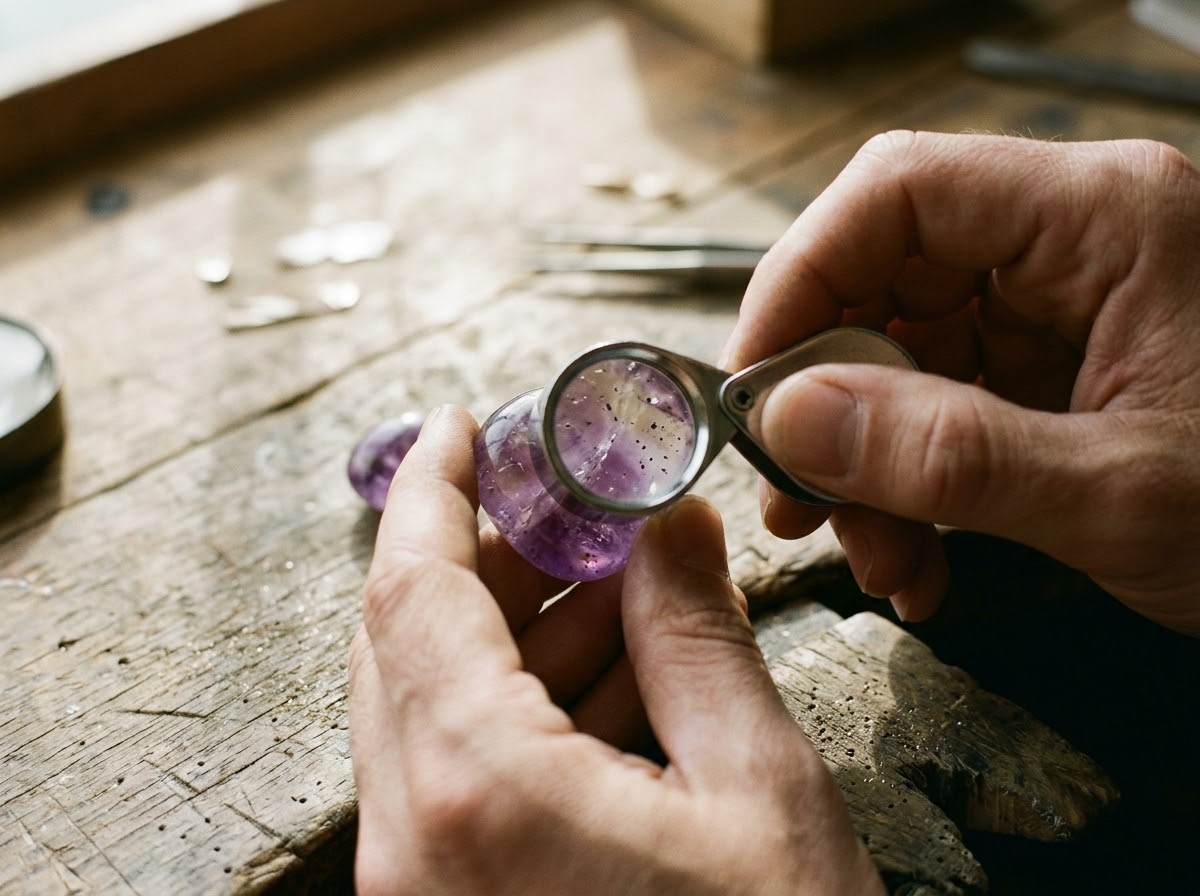
Purple glass and synthetic (lab-grown) amethyst are both common. Glass can usually be spotted at home. Synthetic amethyst, however, is chemically the same as natural amethyst, so a firm answer needs a gemmological laboratory.
| Check | Natural amethyst | Purple glass | Synthetic amethyst |
|---|---|---|---|
| Colour | Usually uneven, with lighter and darker zones | Often perfectly even | Often even and very vivid |
| Under a loupe | Small fractures, crystal or fluid inclusions | Round gas bubbles, swirl marks | Very clean, few inclusions |
| Hardness | 7: steel will not scratch it | About 5.5: steel can scratch it | 7 |
| Surface | Rough pieces show crystal faces and broken surfaces | Mould lines, over-rounded edges | Hard to separate from natural once cut |
| Price | Varies with size and colour | Suspiciously cheap | Cheaper than natural |
Only try a scratch test on a hidden corner of a rough piece; scratching a polished stone or a piece of jewellery damages it. For a valuable stone, ask for a certificate from a recognised laboratory.
What Makes One Amethyst Worth More Than Another?
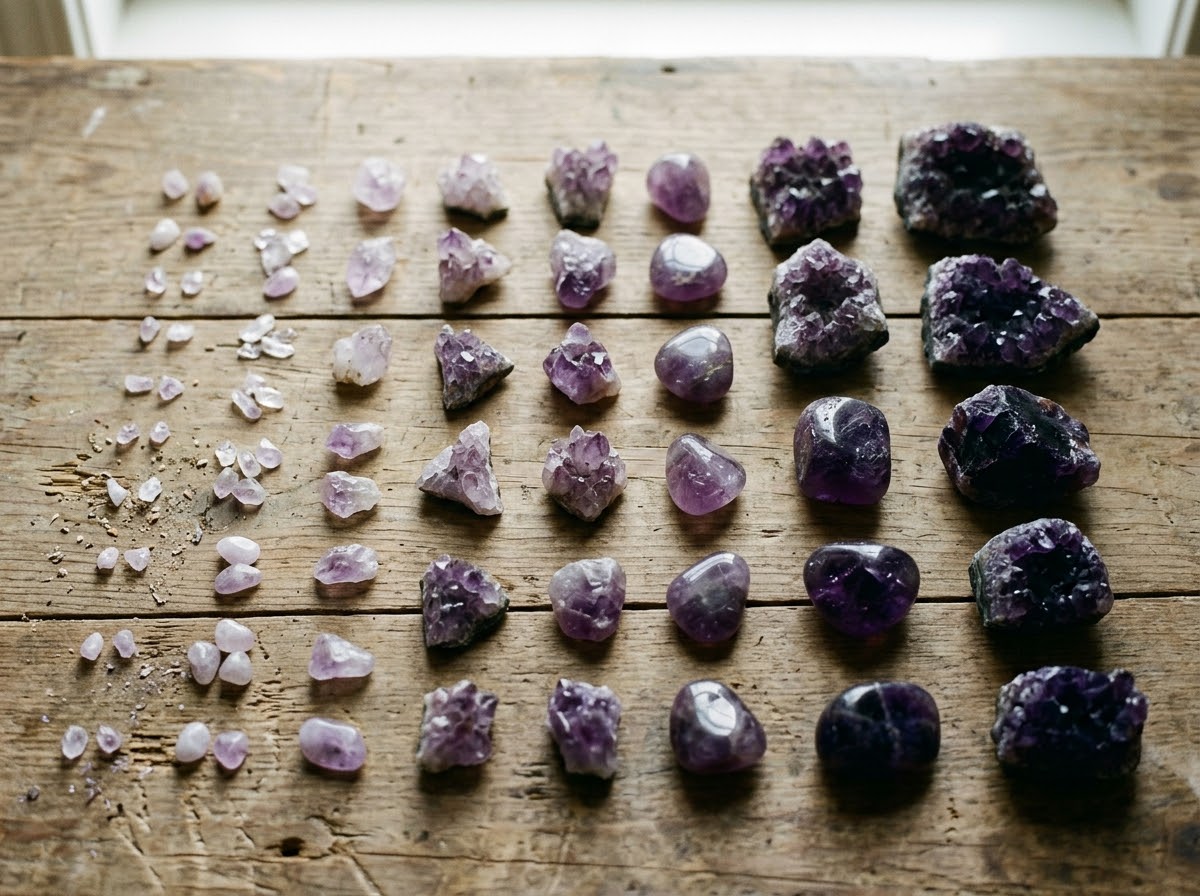
Amethyst is plentiful, so ordinary pieces are inexpensive. Value rises with the depth and evenness of the colour (a rich, even purple is prized over pale or patchy stones), with clarity, with size, and, for specimens, with a well-formed crystal habit. Heat treatment, lab growth and cutting quality all affect the price, which is why the same weight of amethyst can sell for very different sums.
Caring for Amethyst
- Clean it with warm soapy water and a soft cloth.
- Avoid steam cleaning and heat; sudden temperature changes can crack the stone.
- Do not leave it in strong sunlight for long periods: some amethyst lightens with prolonged exposure to intense light, and faded colour does not come back.
- Store it somewhere cool and dark, away from harder gemstones that could scratch it.
The Name and Its History
The word comes from the Greek a- (“not”) and methystos (“intoxicated”). The ancient Greeks believed the stone guarded against drunkenness, and a later myth tells of a maiden called Amethystos turned to stone while fleeing the wrath of Dionysus, god of wine.
Amethyst has been used in jewellery since ancient Egypt. In the Catholic Church a bishop’s ring is traditionally set with an amethyst, and today the stone is best known as the birthstone for February.
Frequently Asked Questions
Is amethyst a type of quartz?
Yes. Amethyst is the violet variety of quartz, with the same formula (SiO₂) and hardness (7); its colour comes from trace iron and natural radiation.
Are amethyst and citrine the same stone?
Both are quartz in different colours. Amethyst heated above about 440 °C turns yellow to orange, and much of the citrine sold today is heated amethyst.
Does amethyst fade in the sun?
Some amethyst lightens after long exposure to intense light, and the lost colour does not return. Keeping it off a sunny windowsill is enough.
Can you find amethyst in Scotland?
Yes, in small amounts. It is recorded at Binn Hill near Glenfarg in the Ochil Hills and at a few other sites, alongside the better-known Scottish agates. Cornwall has amethyst in some of its mines and veins too.
How can I tell if amethyst is real?
Natural amethyst usually has uneven colour and small inclusions under a loupe; glass tends to be perfectly even and may contain round bubbles. Synthetic amethyst is chemically identical to natural, so only a gemmological laboratory can tell them apart with certainty.