
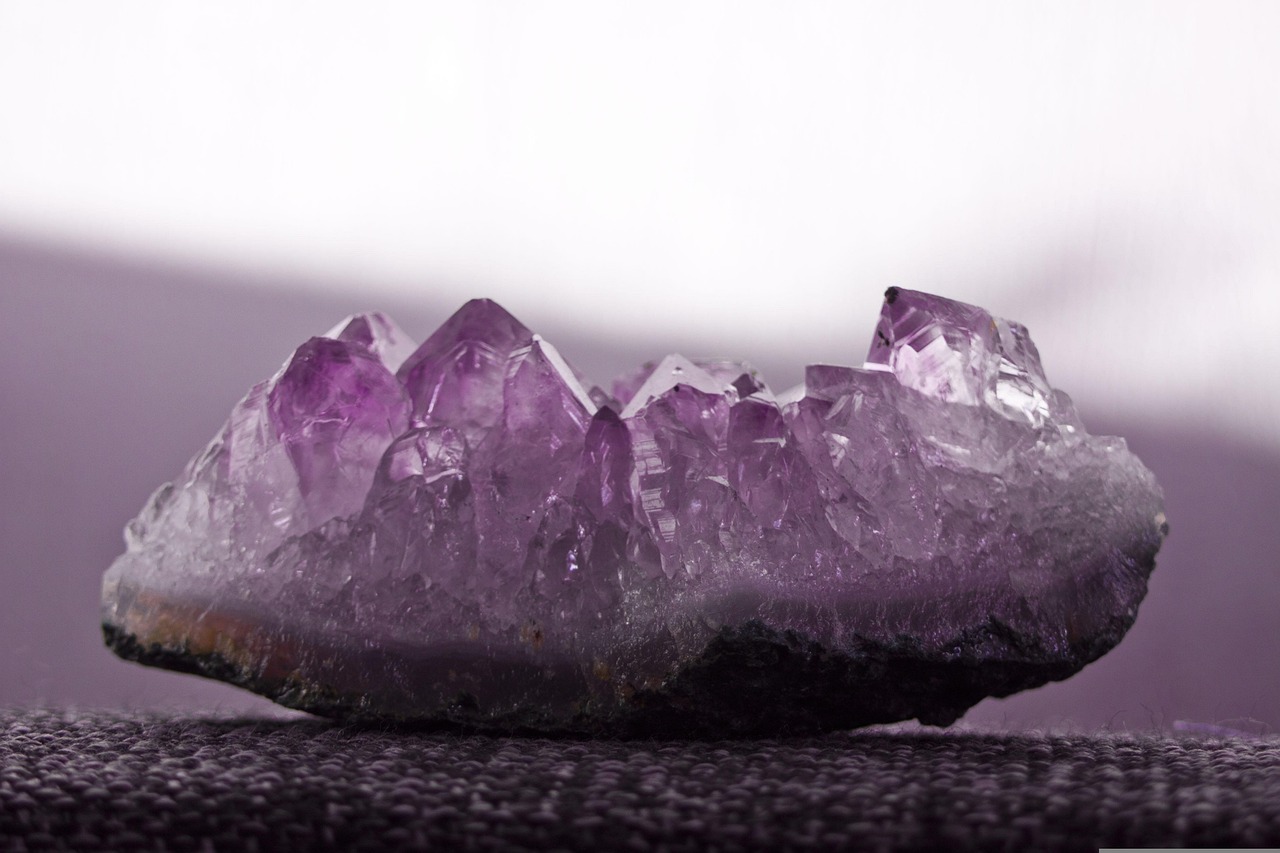
Amethyst is the violet member of the quartz family and one of the world’s most popular semi-precious stones. Its name comes from the Greek amethystos, meaning “not drunk” — a reference to the ancient belief that the stone could guard against intoxication. Few minerals look this dramatic while remaining as widely affordable.
Why It Is Violet
The purple colour is not painted on from outside. It arises inside the crystal from iron ions (Fe³⁸) combined with natural radiation. As iron impurities enter the quartz, gamma radiation from surrounding rocks over millions of years excites those iron atoms, giving birth to the violet tone. The deeper and richer the purple, the more value collectors tend to place on the piece.
Heat changes everything. Around 470–750°C, amethyst shifts to a yellow-brown citrine; at roughly 550°C it can turn colourless. Much of the citrine sold commercially is actually heat-treated amethyst — a piece of everyday jewellery trade that few buyers stop to question.
Where It Is Found
Brazil leads the world in amethyst production, with enormous geodes in Rio Grande do Sul and Minas Gerais. Uruguay is prized for its deep, almost black violets. Zambia supplies much of Africa’s amethyst, cutting stones that are notably clear and vivid. Historically, the finest pieces came from Siberia in Russia, though production there has declined. Closer to the site’s home turf, small but distinct deposits also exist in Turkey, around Balıkesir, Ordu and Yozgat.
A Stone With a Long Memory
Humans have been drawn to amethyst for thousands of years. In ancient Greece it was worn for protection against the wrath of Dionysos — the god of wine — with a myth telling of a nymph named Amethystos turned to stone. Egyptian pharaohs set it in jewellery and protective amulets. In medieval Europe it became the stone of kings and bishops, earning the name “bishop’s stone” and still appearing in Catholic episcopal rings today.
Spotting the Real Thing
Fakes — often painted glass or synthetic quartz — are common in the market. Genuine amethyst rarely shows an even colour; look for subtle zoning where darker and lighter bands meet. A uniform, perfectly saturated tone should raise suspicion. The stone sits at 7 on the Mohs hardness scale, so a steel blade will not scratch it. It feels cool to the touch, unlike glass which warms quickly, and a magnifying glass may reveal air bubbles in glass imitations. Any price that seems too good to be true almost always is.
Caring for Amethyst
Clean amethyst with warm soapy water and a soft brush. Avoid ultrasonic cleaners, which can crack the stone. Keep it away from prolonged direct sunlight — the colour can fade — and from sudden temperature swings. Store it apart from harder stones such as diamond, sapphire or ruby so the surfaces are not scratched.
Whether you hold a cathedral-sized geode or a small pendant, amethyst carries millions of years of the earth’s history in a single, vividly purple crystal — a beauty that is as accessible as it is ancient. Like opal, which scatters the rainbow from a different mechanism entirely, amethyst shows how a single mineral can produce a whole world of colour.