
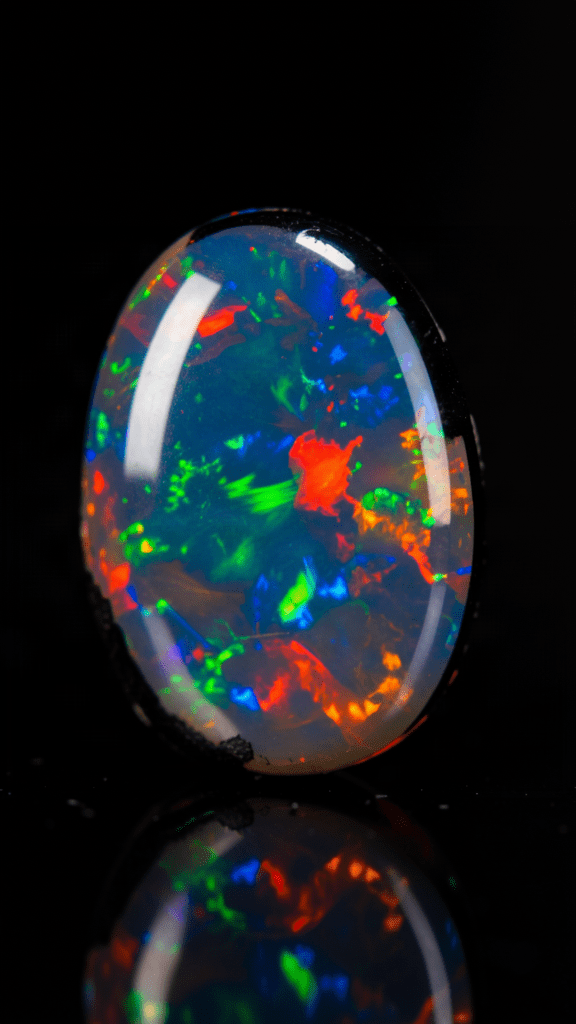
Opal is unlike any other gemstone. While most minerals owe their beauty to crystal structure, opal’s magic comes from packing — billions of microscopic silica spheres stacked in an orderly, repeating array rather than a true crystal lattice. When light enters this array, it bends and scatters, splashing the stone with every colour of the rainbow. This is the “play-of-colour” that has captivated humans for thousands of years.
What Makes Opal Unique
Chemically, opal is hydrated silica (SiO₂·nH₂O) — essentially quartz with water molecules trapped inside. Unlike crystalline gemstones, opal is amorphous: it has no defined crystal shape. The water content can range from 3% to 21%, which makes opal softer and more delicate than most gemstones, rating 5.5 to 6.5 on the Mohs hardness scale.
The famous play-of-colour comes from those tiny silica spheres. When they’re roughly the same size and packed in an orderly grid, they act as a natural diffraction grating. The size of the spheres determines which colours appear: smaller spheres produce blue and violet, while larger ones bring out reds and oranges. The most valuable opals show the full spectrum against a dark body colour.
Where Opal Comes From
Australia dominates opal production, supplying roughly 95% of the world’s gem-quality opals. The harsh outback towns of Coober Pedy, Lightning Ridge, and Andamooka sit atop ancient inland seabeds where silica-rich water seeped into cracks and cavities over millions of years, slowly depositing layer upon layer of microscopic spheres.
Significant deposits also exist in Ethiopia, where opals formed in volcanic rocks rather than sedimentary layers. Ethiopian opals tend to have higher water content and can display spectacular play-of-colour, though they’re more prone to cracking if they dry out too quickly. Smaller sources include Mexico, Brazil, and the United States.
A Stone of Many Faces
Not all opals shimmer. Common opal, or “potch,” lacks the ordered silica spheres needed for play-of-colour, appearing in milky whites, soft pinks, and dull blues. Fire opal, found mainly in Mexico, glows with a warm orange-to-red body colour that comes from iron impurities — no play-of-colour required. Boulder opal forms as thin veins running through ironstone, creating dramatic dark backgrounds that intensify whatever colour flashes through.
The rarest and most prized variety is black opal from Lightning Ridge, Australia. Its dark body tone — ranging from deep grey to jet black — provides the perfect canvas for full-spectrum colour play. A top-quality black opal can command prices higher than diamond per carat.
Care and Mythology
Opal’s water content makes it vulnerable. Sudden temperature changes, prolonged dry air, or harsh chemicals can cause cracking — a phenomenon called crazing. It’s best stored away from direct sunlight and occasionally wiped with a damp cloth to prevent dehydration.
Throughout history, opal has collected a rich mythology. The ancient Greeks believed it gave the power of prophecy. Roman scholar Pliny the Elder described it as a stone combining the beauty of all gems. In Arabic tradition, opals were said to have fallen from the sky in flashes of lightning. The unfortunate superstition that opal brings bad luck — popularised by Sir Walter Scott’s novel Anne of Geierstein — has no basis in any older tradition. October’s birthstone deserves better than a fictional curse.