
Walk through London on a November evening and you will smell them before you see them: chestnuts blackening over charcoal, sold by the handful in paper cones. The braziers appear with the first cold snap and stay until the Christmas markets close. Behind that smell stands a tree that has been part of the European landscape for thousands of years — and that still shapes a handful of English woods.
The sweet chestnut is easy to love and surprisingly easy to get wrong. It spoils quickly, it rewards patience at harvest time, and every year someone confuses it with the conker. This is a short guide to the tree, the harvest, storage and the kitchen.
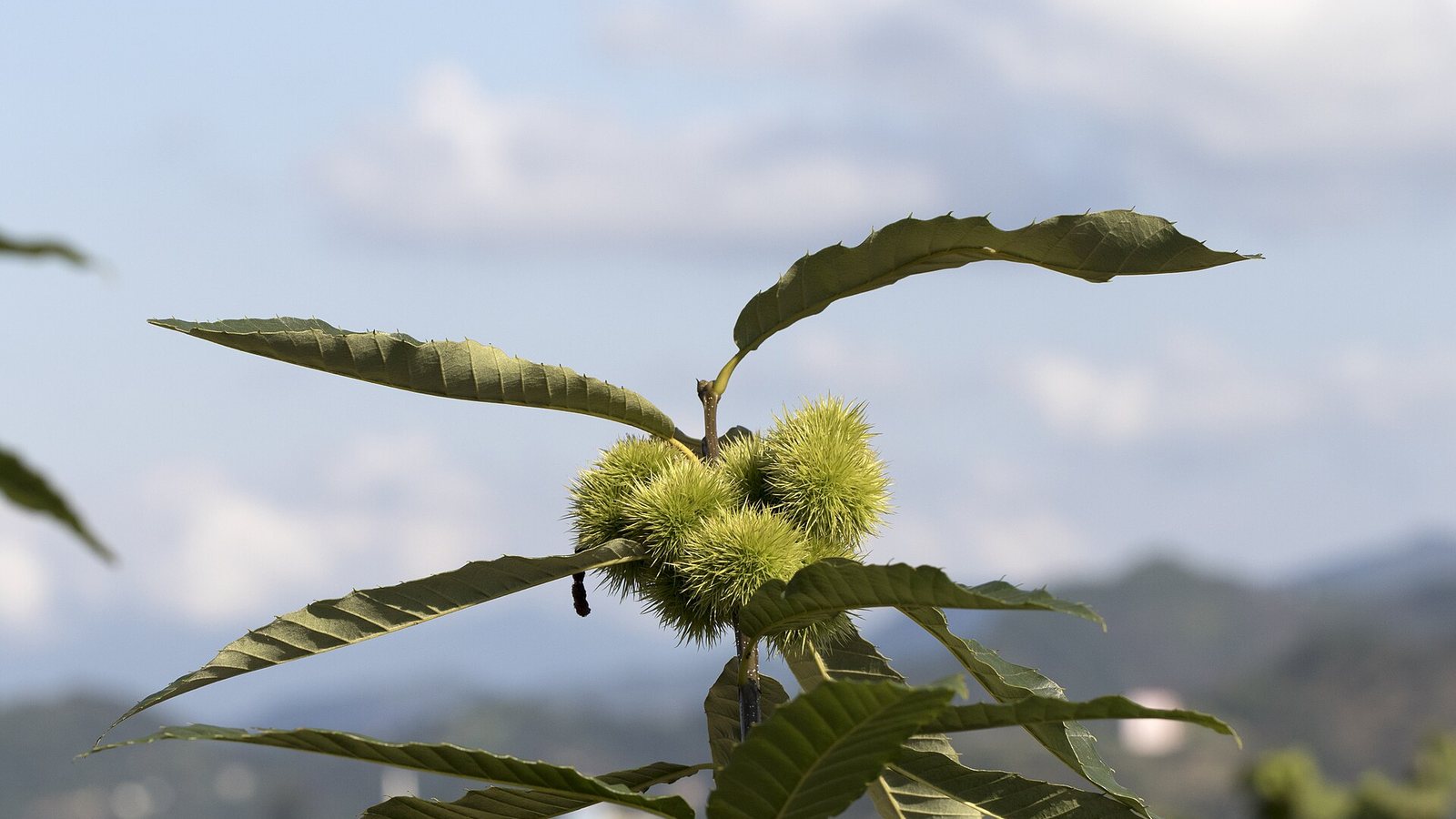
A treasure inside a spiny bur
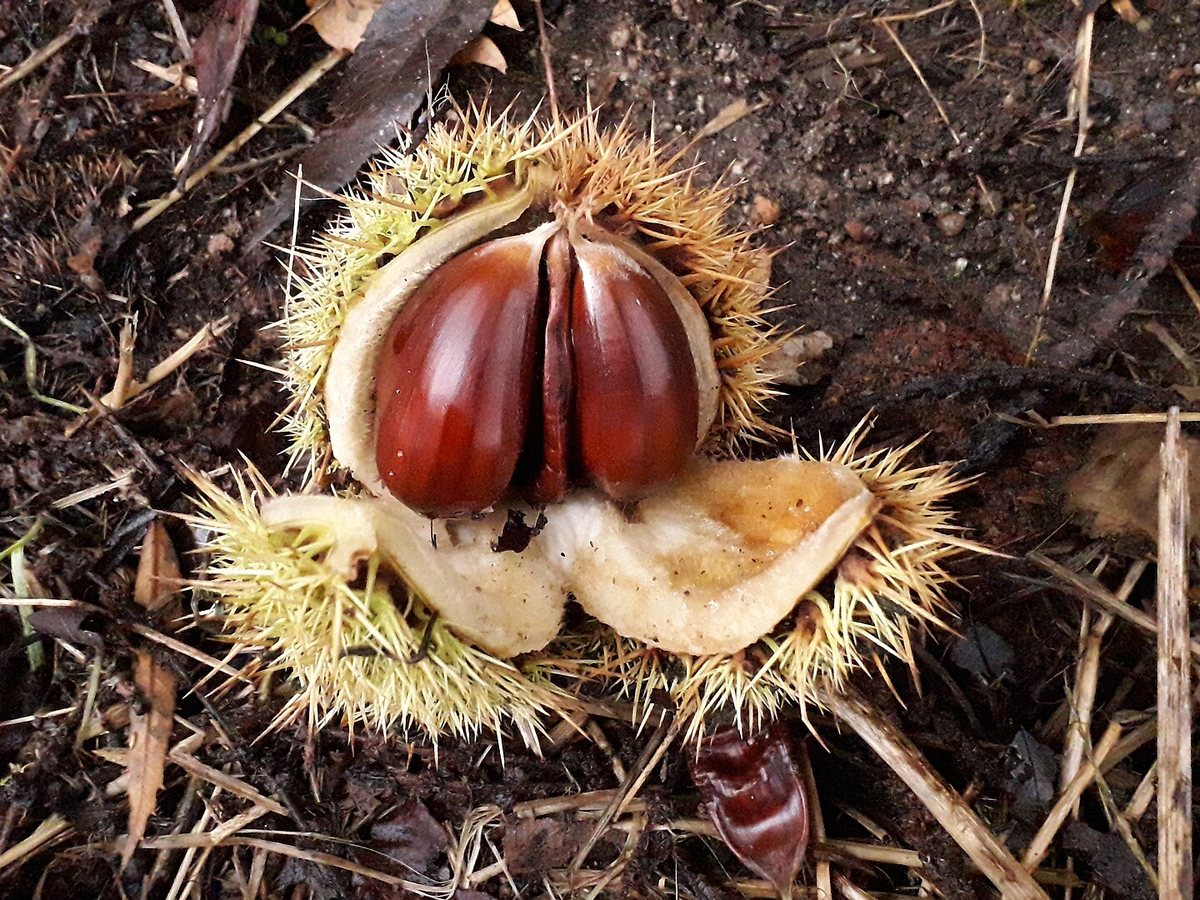
The glossy brown nut is what we call the chestnut; the spiky case around it is the bur. In late summer the bur is green and soft. By autumn it hardens, turns brown and splits open, usually releasing two or three nuts.
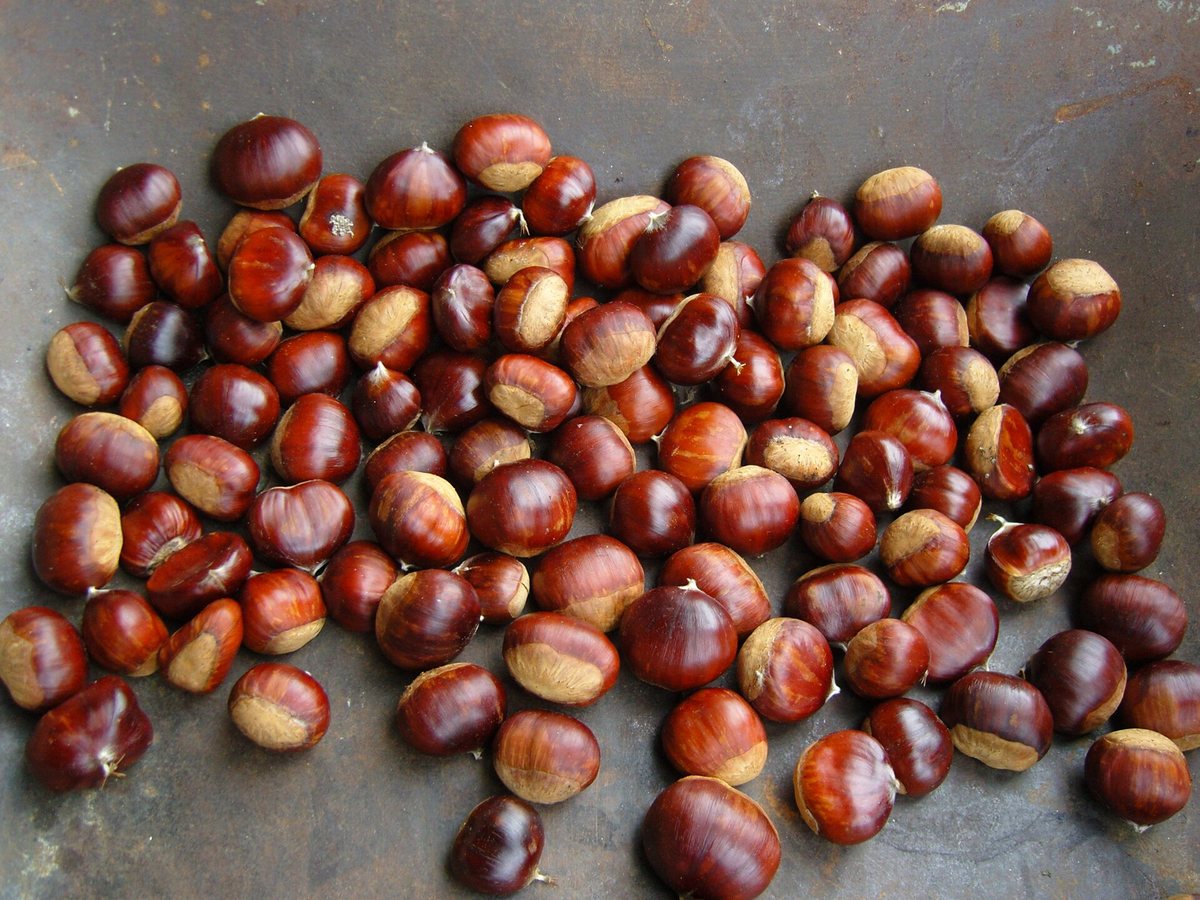
A good chestnut feels heavy, firm and shiny. At its base you will see a pale, slightly downy patch where it was attached to the bur. That patch is one of the most honest signs of freshness: if it has darkened, the nut is past its best.
Castanea sativa: an old companion of southern Europe
The sweet chestnut, Castanea sativa, belongs to the beech family, Fagaceae, alongside oaks and beeches. According to the European Atlas of Forest Tree Species, its natural range covers southern Europe and reaches east into Anatolia and the Caucasus. The same atlas notes that the first clear evidence of chestnut cultivation comes from the eastern Mediterranean, dating to around 2100–2050 BC — which makes the chestnut one of the oldest trees people have deliberately planted for food.
Today chestnut woodland covers more than 2.5 million hectares in Europe. Much of it depends on people: neglected chestnut stands are gradually invaded by other species and lose their character.
Recognising the tree
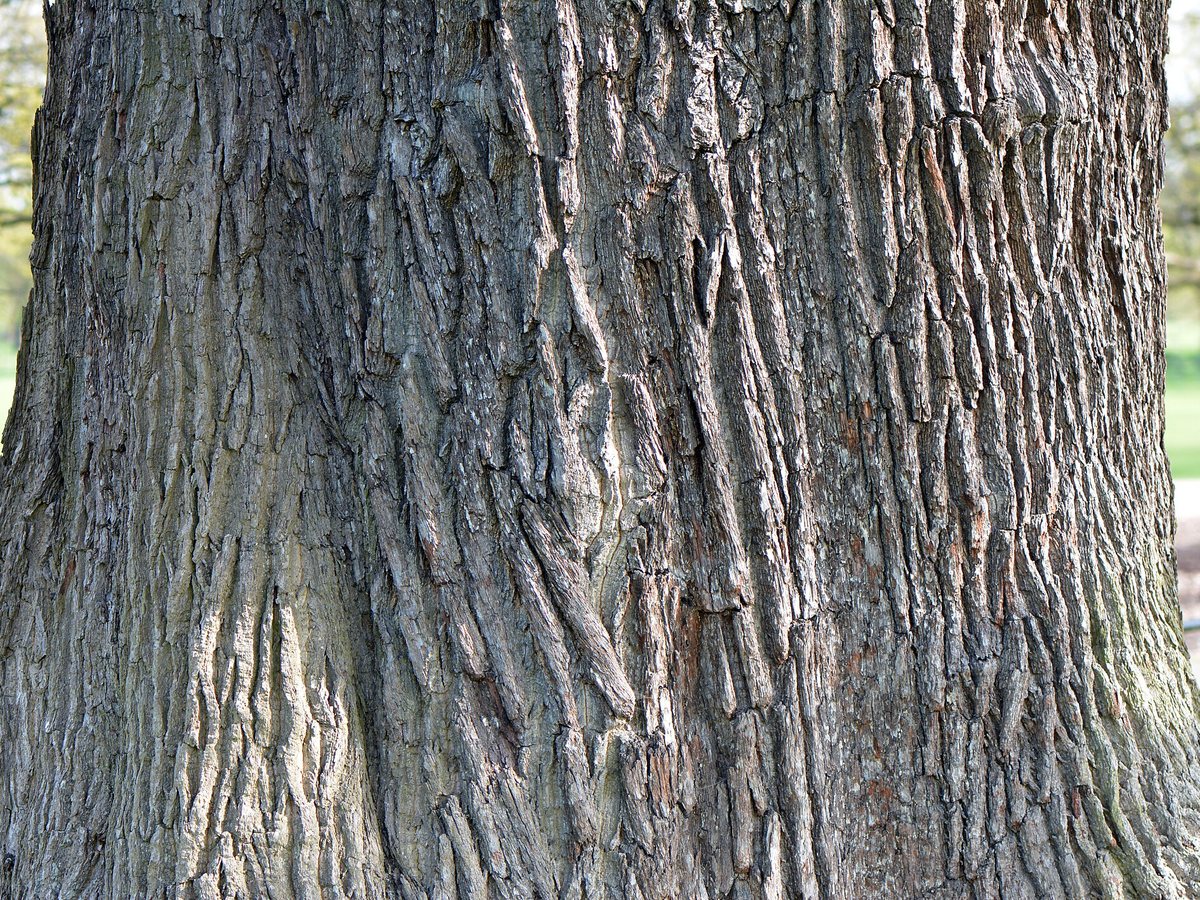
A mature sweet chestnut can reach 30–35 metres, with a trunk 1.5–2 metres across. As it ages, the bark breaks into deep furrows that run the length of the trunk, often with a slight twist. It is one of the easiest ways to pick out a chestnut in a mixed wood.
- Leaves: long, narrow and sharply toothed. Each leaf is a single blade, not divided into the hand-like leaflets of the horse chestnut.
- Flowers: long, yellowish catkins in June and July, with a strong scent that draws in bees.
- Fruit: glossy, starchy nuts inside a spiny bur.
Chestnut woods are bee country, too. Chestnut honey, made from the summer flowers, is dark, sharp and faintly bitter, and quite unlike milder floral honeys.
The harvest: a lesson in patience
The harvest runs from September to November and follows the tree’s own timetable. The best practice is to wait until the burs split and the nuts drop of their own accord, when they are fully ripe. Beating the branches is quicker, but part of the crop comes down unripe and tastes flat.
The real enemy is moisture. A chestnut that lies on wet ground for too long is open to fungal infection, so growers spread nets under the trees, collect several times a day and keep the nuts in ventilated baskets in the shade. The UN Food and Agriculture Organization sums up good postharvest practice in three words: cleanliness, care and cooling.
Chestnuts in Britain: coppice woods and street braziers
Britain sits at the northern edge of the chestnut’s comfort zone, and the tree behaves differently here. It was probably brought over by the Romans, and it has been coppiced for centuries: cut back to the ground on a cycle of roughly ten to twenty years so that it throws up straight poles for fencing, hop poles and roof laths. The woods of the Weald, spread across Kent, Surrey and Sussex, were worked this way for so long that sweet chestnut coppice became part of the landscape. Kent and Sussex still hold some of the finest stands, alongside a few trees old enough to have grown far past the coppice cycle.
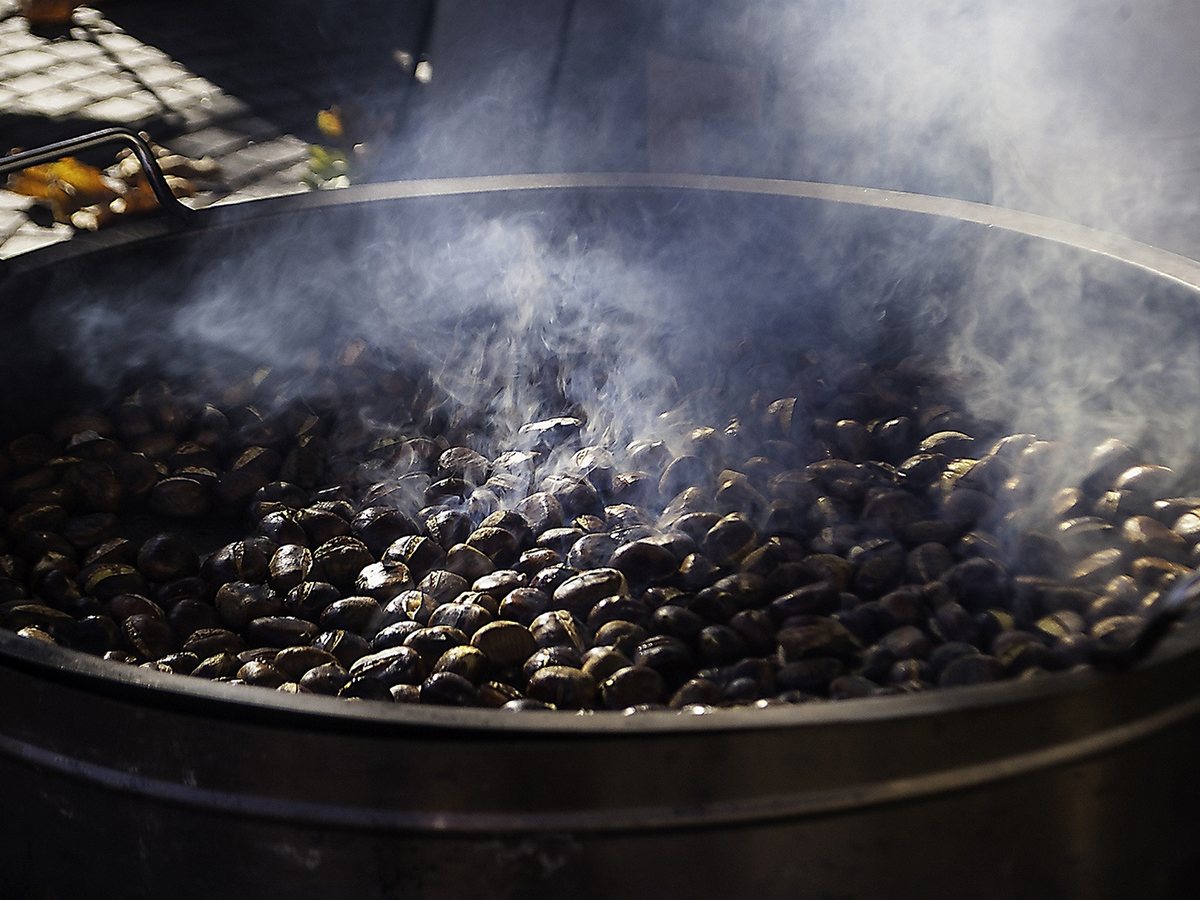
Roasting, meanwhile, is an urban ritual rather than a rural one. Chestnuts sold at British braziers are mostly imported — Spain and Italy are the big suppliers — and the trade appears in November and vanishes after Christmas. In the woods the crop matters for a different reason: chestnut coppice is one of the few genuinely renewable sources of hardwood in Britain, and the poles it produces still go into fencing and garden hurdles.
The tree is long-lived but not tough in every sense: it needs moisture and suffers in drought, which is why it thrives on hillsides rather than on the dry plains.
Don’t confuse it with the conker
Every autumn brings the same news: people poisoned by “chestnuts” picked up in a park. The culprit is the horse chestnut (Aesculus hippocastanum), whose seeds are the conkers children play with. France’s food safety agency, ANSES, reviewed poison centre records from 2012 to 2018 and found that confusion between horse chestnuts and sweet chestnuts accounted for 11% of cases in which a toxic plant was eaten by mistake. Horse chestnuts are not edible and can cause abdominal pain, nausea, vomiting and throat irritation.
Three signs tell them apart:
- The bur: a sweet chestnut’s bur is brown and densely covered in long spines, with two or three small, flattened, triangular nuts inside. A horse chestnut’s case is thick, green and studded with short, sparse spikes, and usually holds a single large, round seed.
- The leaves: sweet chestnut leaves are single, long and toothed; horse chestnut leaves are palmate, made of several oval leaflets.
- The setting: sweet chestnuts grow in woods, coppices and orchards; horse chestnuts are mostly planted in streets, parks and school grounds.
If in doubt, don’t eat it. ANSES also advises keeping leftovers or a photo of what was picked, which helps doctors if anyone falls ill.
Storage: the chestnut’s weak point
Unlike walnuts or hazelnuts, chestnuts do not keep. Their skins are thin and they hold a lot of water, so at room temperature they go mouldy or dry out rock-hard within days. Sort them the day you buy them and discard any with holes, any that feel light and any with a darkened base.
- In the fridge: in a perforated bag or open container in the salad drawer, they last one to three weeks. A sealed bag makes them sweat and go mouldy sooner.
- In the freezer: score the shells, boil for a few minutes, drain, cool and freeze them in their shells or peeled. They will keep for months.
- Dried: spread in a single layer in a cool, airy place. Dried chestnuts go hard and are softened again by simmering.
In the kitchen: from embers to flour
Roasting is the classic, but always score the shell with a knife first. Otherwise the steam inside builds up and the chestnut bursts in the fire. The same cut helps when boiling: the nut cooks evenly and the shell comes away easily.
Chestnut flour is the quiet workhorse of Mediterranean kitchens. It contains no gluten, so it rises poorly on its own and is usually blended with other flours, or used to add body and a gentle sweetness to cakes, soups and pastries.
Chestnuts in brief
- One of Europe’s oldest cultivated trees, with clear evidence of cultivation in the eastern Mediterranean from around 2100 BC; in Britain, probably a Roman introduction.
- Harvested from September to November, once the bur splits and the nuts fall.
- Told apart from the toxic horse chestnut by the bur, the leaves and where the tree grows.
- Moisture and warmth are its enemies: fridge, freezer or drying are the safe options.
Next time you hold a warm paper cone of roasted chestnuts, remember what is inside: a nut that ripened slowly in a spiny bur, was gathered by hand from the ground, and has been cultivated around the eastern Mediterranean for some four thousand years.
If you enjoy landscapes shaped by geology and season, two more pieces sit close to this one: the limestone towers and alpine forests of the Dolomites, and the white shores and turquoise water of Lake Salda.
Sources
- European Commission Joint Research Centre, European Atlas of Forest Tree Species: Sweet chestnut
- ANSES, Horse chestnuts and sweet chestnuts: how to tell them apart
- FAO, Postharvest Handling and Storage of Chestnuts
- Forestry Commission, Forestry in the Weald — Kent, Surrey, Sussex and eastern Hampshire
- Forest Research, Sweet chestnut (Castanea sativa)
Photographs: Wikimedia Commons — Zeynel Cebeci (CC BY-SA 4.0), Lamiot (CC BY-SA 4.0), Feranza (CC BY-SA 4.0), NikolaR / Pixabay (CC0), Certo Xornal (CC BY 2.0).