
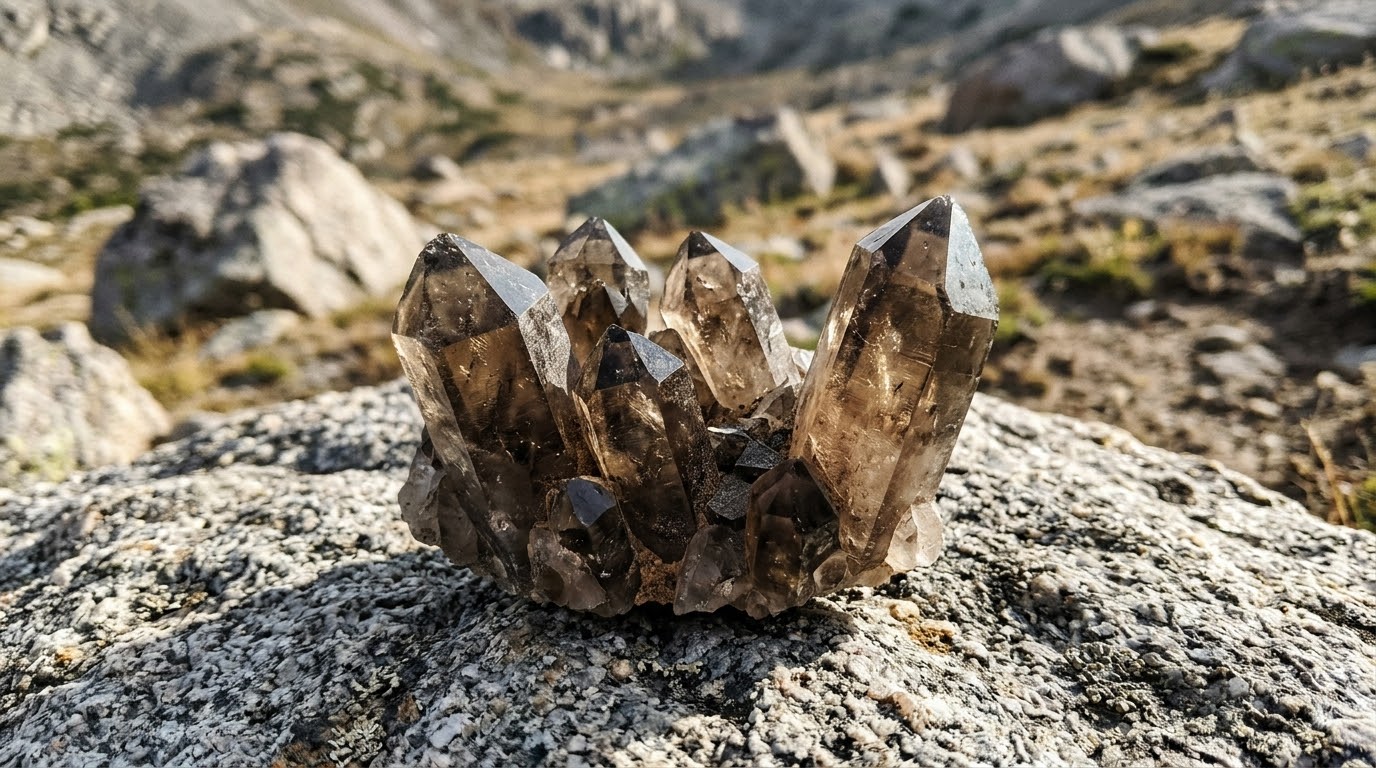
Smoky quartz is the quiet member of the quartz family: a stone that runs from pale grey to deep brown, sometimes almost black, and still lets light through. Nothing is dyed into it and no second mineral supplies the colour. It comes from natural radiation in the rocks that surrounded the crystal for millions of years. This article looks at where that colour comes from, where the stone forms, how to tell a natural piece from one darkened in a laboratory, and what science says about the “benefits” so often attached to it.
What is smoky quartz?
Chemically it is ordinary quartz: silicon dioxide (SiO2), hardness 7 on the Mohs scale and a density of about 2.65 g/cm³. Its crystals grow as six-sided prisms ending in a point, and only the colour separates them from rock crystal. If you want the mineral in the round, read what quartz is, its properties and varieties.
Different shades carry different names. The near-opaque, almost black variety is called morion. In Scotland, the brownish-yellow smoky quartz of the Cairngorm mountains is known simply as cairngorm and has been set in Scottish jewellery for centuries. The violet member of the same family is described in our article on amethyst.
Where the colour comes from
As the crystal grows, a small amount of aluminium takes the place of some silicon atoms in the lattice. Because its electrical charge differs, a compensating ion settles nearby: lithium, sodium, potassium or hydrogen. At this stage the crystal is still colourless.
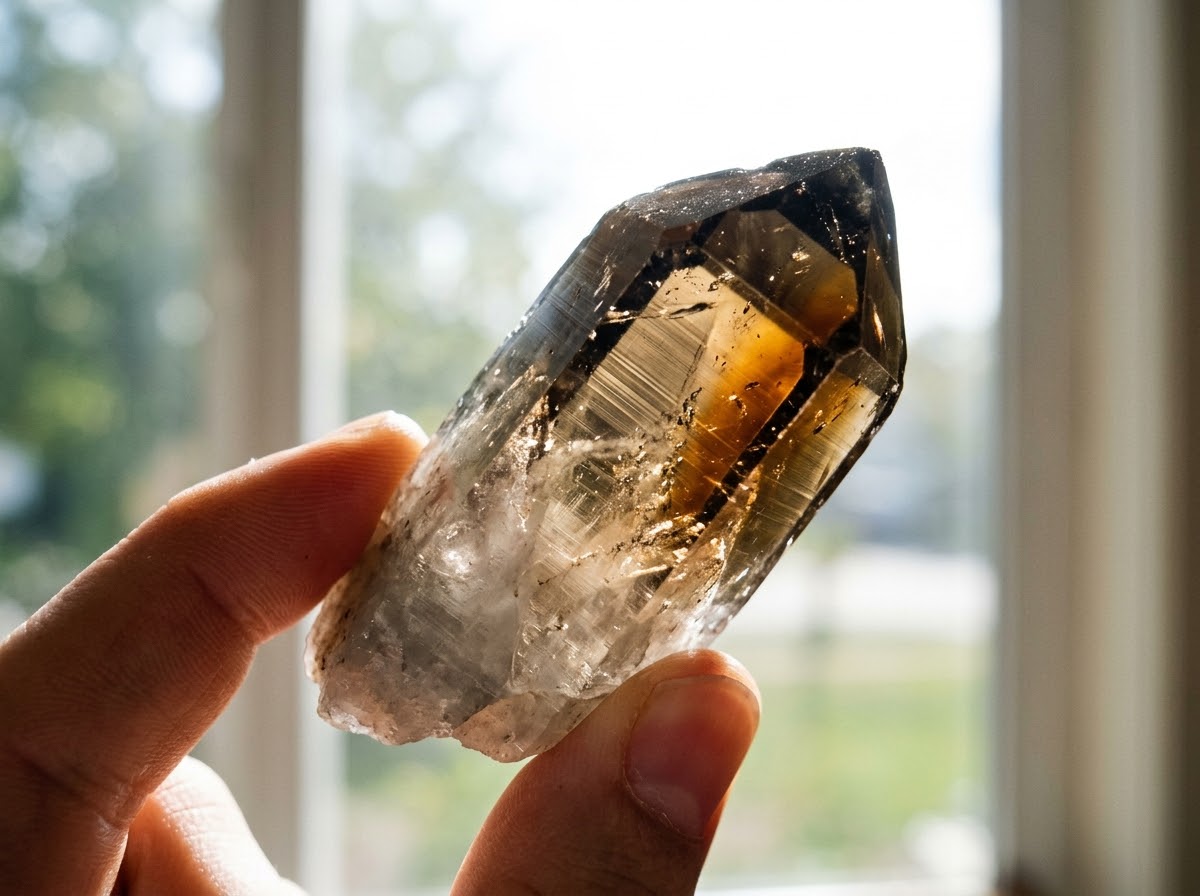
The colour appears in a second step. Natural gamma rays from radioactive elements in the surrounding granite displace electrons around the aluminium, creating colour centres that absorb part of the light. The mineralogists Kurt Nassau and Brian Prescott examined these centres in 1977 by irradiating hundreds of quartz samples (Mineralogical Magazine).
The colour has a weakness: heat. Warm the stone and it fades; sources put the start of the change at around 200 °C, and at higher temperatures a crystal can turn almost colourless or shift towards yellow and green.
Where it forms
Smoky quartz grows mostly in cavities within granites and coarse-grained pegmatite veins. Radioactive rocks supply both the space for the crystal and the radiation that colours it.
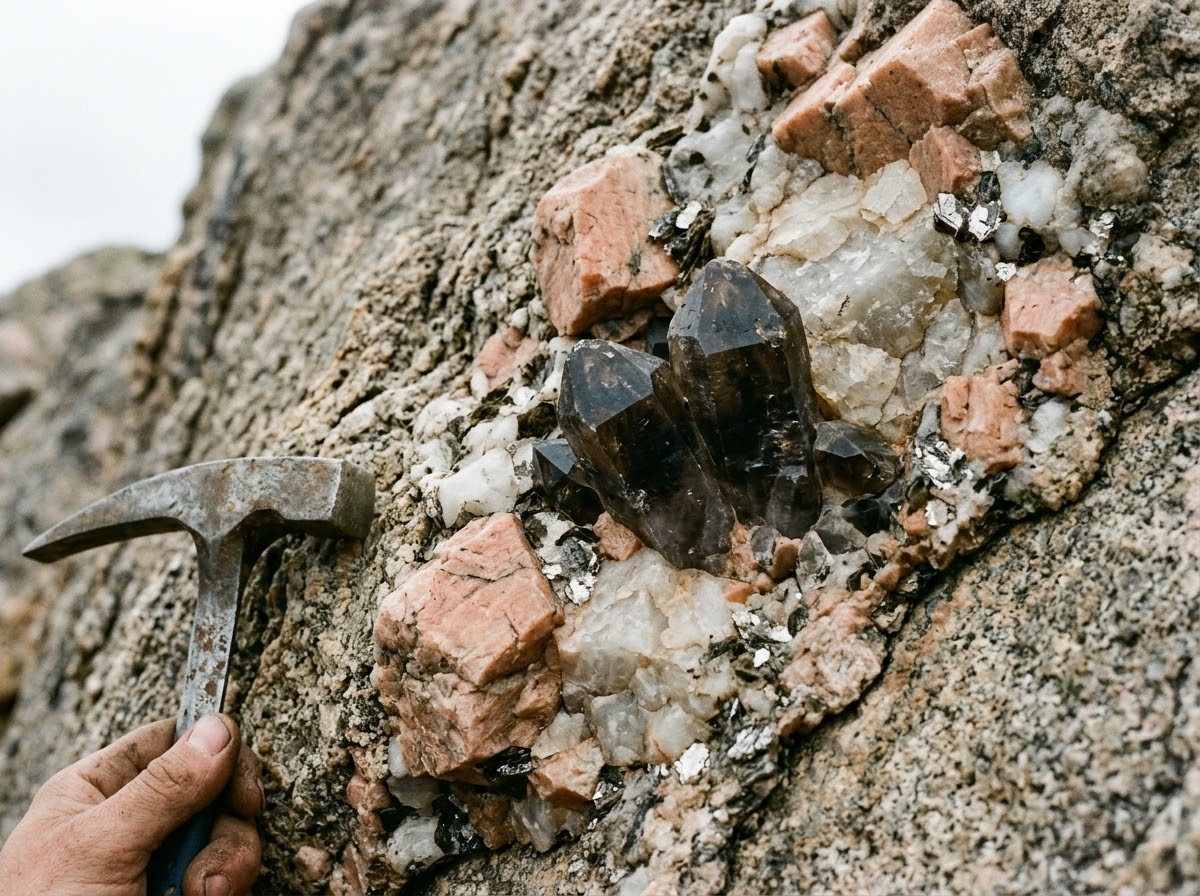
Among the best-known deposits are the crystal fissures of the Swiss Alps, Minas Gerais in Brazil, Madagascar and the Pikes Peak region of Colorado, where smoky quartz appears alongside blue-green amazonite and is prized by collectors.
Natural or irradiated?
If you are buying smoky quartz, this is the part to know: much of the dark material on the market is colourless quartz irradiated in a laboratory. The treatment speeds up what nature does slowly and does not change hardness or durability, and pieces are processed so that no residual radioactivity remains. The problem is not the treatment but the silence around it: a treated stone should not carry the price of a natural one.
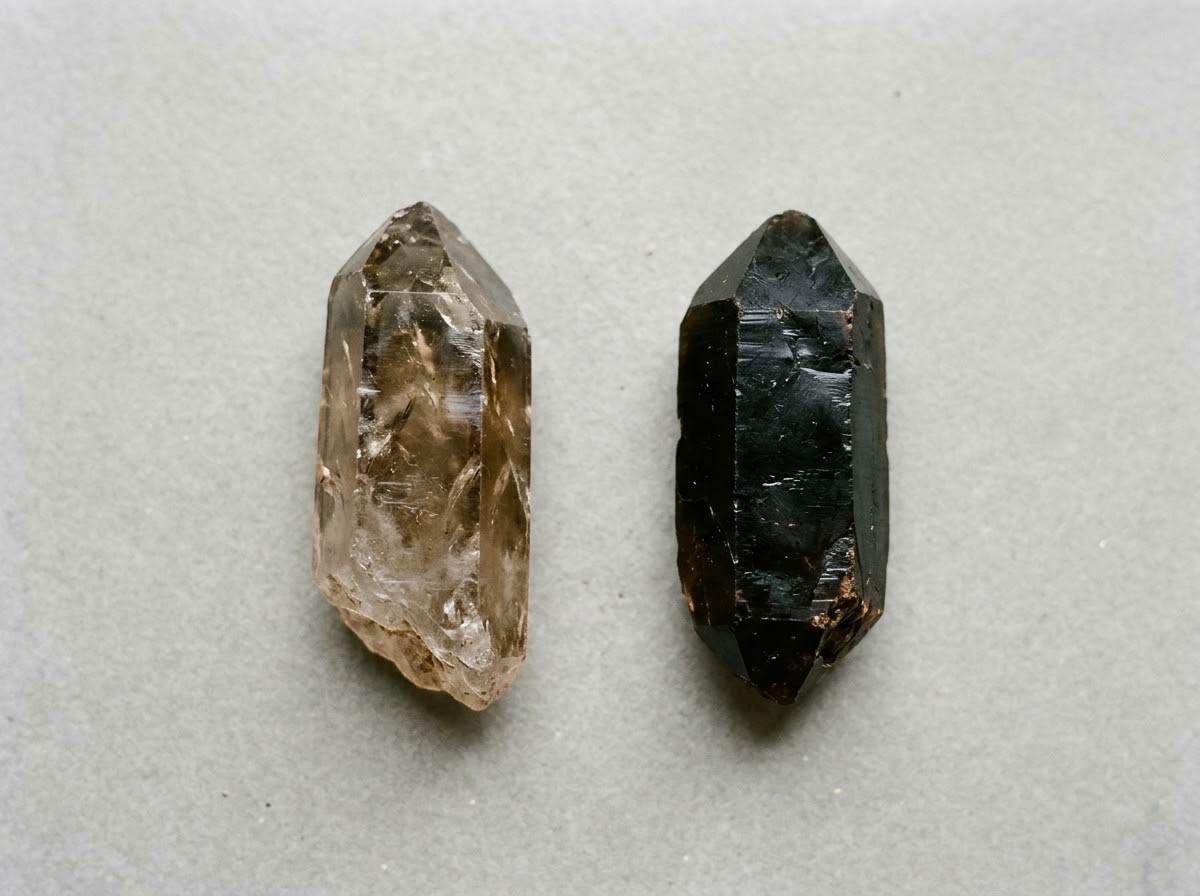
A reliable separation by eye is rarely possible, but there are clues:
- Colour zoning: natural smoky quartz is usually brownish or grey and uneven, darkening towards the tip while the base stays pale. Irradiated pieces tend to be very dark and uniform.
- Nearly black, opaque stones: if a piece is sold as natural morion, its locality and provenance should be documented.
- The definite answer is in a laboratory: a well-executed irradiation can only be shown by spectroscopic measurement. For an expensive piece, ask for a gemmological report.
The most practical step is to ask the seller directly whether the stone has been treated and where it came from. A written answer is worth more than a label on the box.
How it differs from citrine and obsidian
Smoky quartz is most often confused with two other stones:
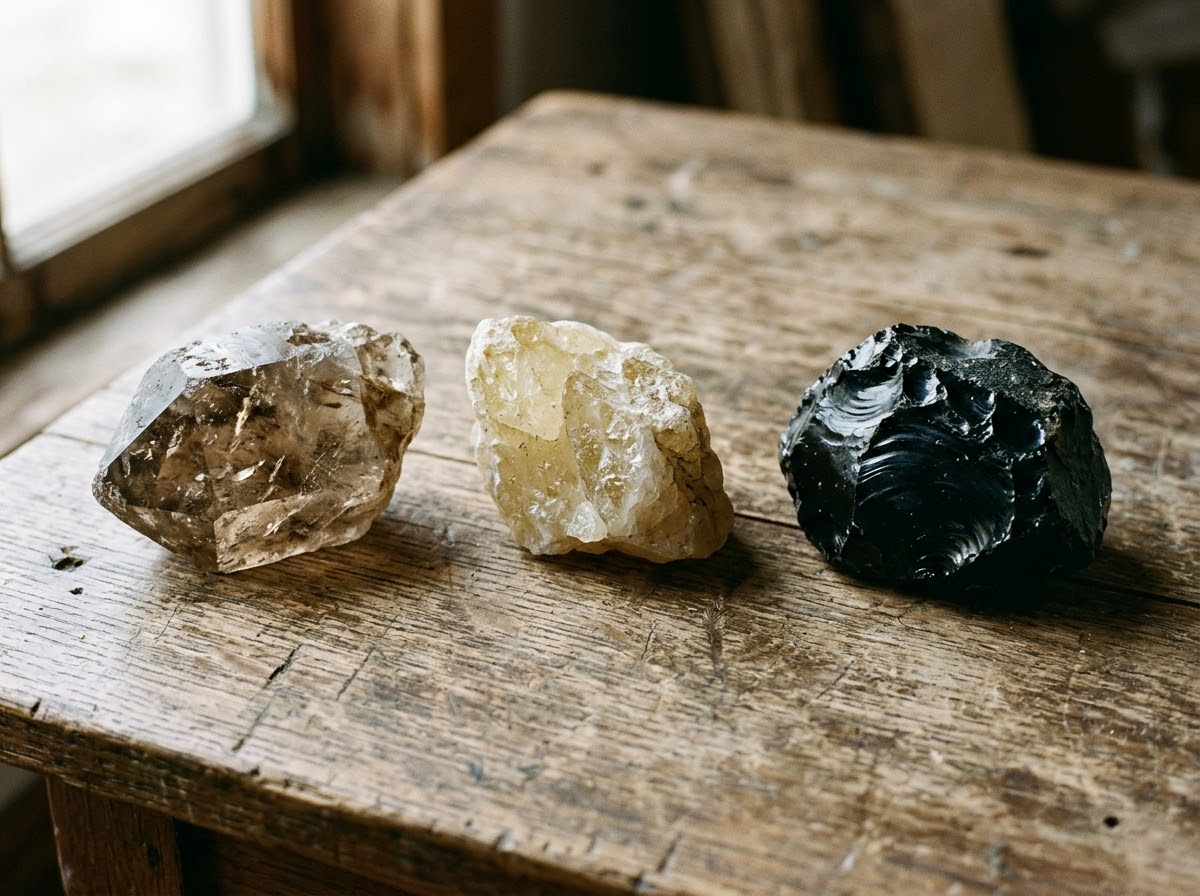
- Citrine is the yellow-orange variety of quartz, while smoky quartz sits in brown and grey tones. Pale smoky pieces can look yellowish, and much of the citrine on the market is heat-treated amethyst. Both are quartz, so hardness is identical; the tone is what separates them.
- Obsidian is not a crystal at all but volcanic glass. It has no crystal faces, breaks with curved, shell-like surfaces and is softer (5–5.5 on the Mohs scale). A glossy, uniform black stone can be either, so look at the shape and the fractures.
“Smoky quartz benefits”: belief and science
“Benefits” are among the most searched questions about the stone. In crystal healing traditions smoky quartz is considered grounding, credited with shielding the wearer from negative energy and easing stress.
There is no reason not to enjoy smoky quartz for its colour and its story. No stone, however, replaces a medical diagnosis or treatment.
What drives the price
Smoky quartz is one of the more affordable varieties of quartz. The price depends mainly on size, transparency, depth of colour, the shape of the crystal and the work involved: cut, polished or set in jewellery. With very dark pieces it is always worth asking whether the colour is natural, because that should be reflected in what you pay. If you are shopping for finished pieces, see our selection of quartz jewellery and accessories.
Care
With a hardness of 7, smoky quartz stands up to daily wear. Even so:
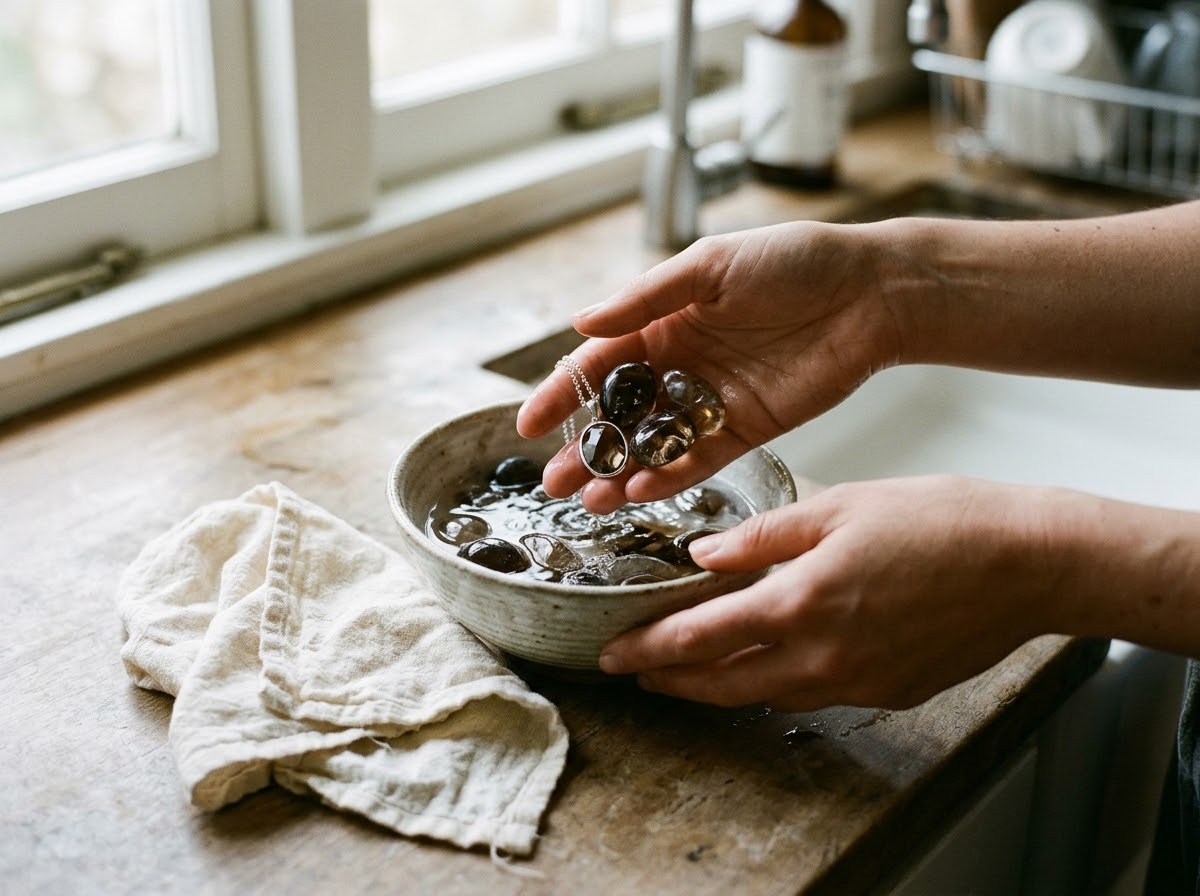
- Clean it with warm water, mild soap and a soft brush, rinse well and dry with a soft cloth.
- Avoid steam cleaning, high heat and sudden temperature changes: they can lighten the colour and cause cracks.
- Do not leave it for long periods in strong sunlight or on a hot car dashboard; some sources note that the colour fades under those conditions.
- Store it apart from harder stones such as sapphire, in its own soft pouch, so that it does not get scratched.
Frequently asked questions
Is smoky quartz a natural stone?
Yes. It forms in nature and takes its colour from radiation in the surrounding rock. A large share of the dark pieces on the market, however, is colourless quartz irradiated in a laboratory, so it is worth asking the seller whether the stone has been treated.
Is irradiated smoky quartz dangerous?
Material sold after irradiation is processed so that no residual radioactivity remains, and the treatment does not change hardness or durability. What matters is that the treatment is declared rather than hidden.
What is morion?
Morion is the name for the darkest, almost black and opaque variety of smoky quartz. A piece sold as natural morion should come with a documented locality.
How can I tell smoky quartz from obsidian?
Smoky quartz is a crystal: it has flat crystal faces and lets light through in a brown-grey tone. Obsidian is volcanic glass, with no crystal faces, curved fracture surfaces and a lower hardness of 5–5.5 on the Mohs scale.
What properties are attributed to smoky quartz?
In crystal healing it is described as grounding and protective. Those claims have no scientific support: controlled experiments found no difference between real crystals and imitations. No stone substitutes for medical treatment.
Does smoky quartz fade in sunlight?
Its colour is sensitive to heat and lightens at high temperatures. Some sources report that stones left in strong sunlight or in hot places fade over time, so cool, shaded storage is the safest option.