
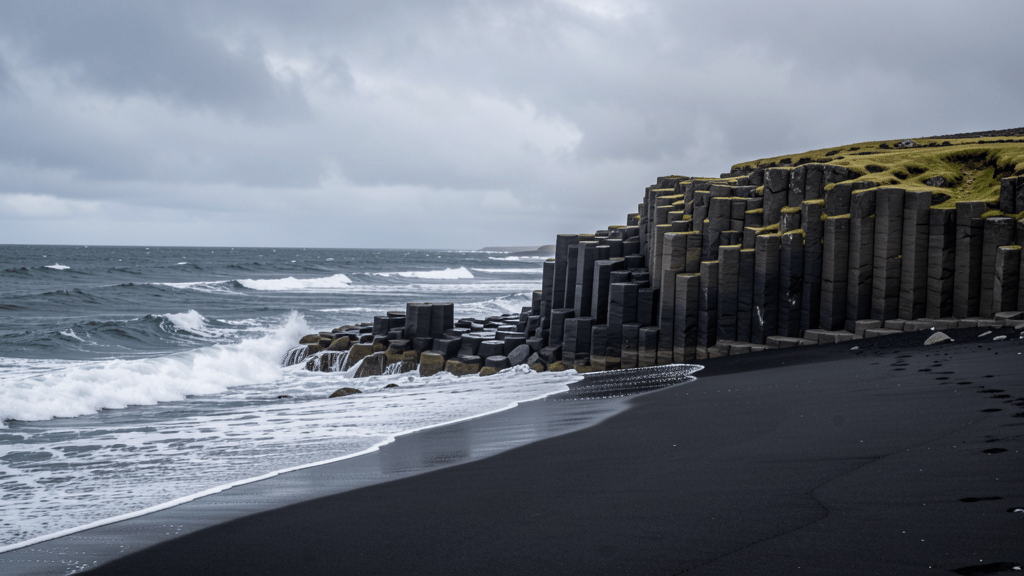
Along the black sand shores of Reynisfjara, on Iceland’s southern coast, nature has sculpted one of its most mesmerising geometric wonders. Towering hexagonal columns of dark basalt rise from the volcanic beach like a cathedral organ, the result of ancient lava flows cooling and contracting with mathematical precision. These basalt columns are not just a geological curiosity — they are a window into Iceland’s violent volcanic soul.
What Are Basalt Columns?
Basalt columns form through a process called columnar jointing, which occurs when thick, slow-cooling lava contracts as it solidifies. As the rock cools from the top and bottom inward, it shrinks and cracks, creating a network of predominantly hexagonal fractures that propagate downward — much like the way mud cracks when it dries. The result is a breathtaking honeycomb-like structure of polygonal pillars, typically 5 to 8 sided, standing shoulder to shoulder in near-perfect symmetry.
Basalt itself is the most abundant volcanic rock on Earth — over 90% of all volcanic rock is basalt. It forms from low-viscosity lava rich in magnesium and iron, cooling rapidly at or near the surface. The same chemical composition that makes it dark and dense also gives it the unique ability to fracture into these striking geometric patterns. The mineral makeup comprises primarily plagioclase feldspar, pyroxene, and olivine — a triad that tells the story of Earth’s mantle brought to the surface.
Iceland’s Volcanic Landscape: A Perfect Laboratory
Iceland sits directly atop the Mid-Atlantic Ridge, where the North American and Eurasian tectonic plates are pulling apart at a rate of roughly 2.5 centimetres per year. This unique geological position makes it one of the most volcanically active places on the planet, with an eruption occurring roughly every 4 to 5 years on average. The island itself is essentially a massive basalt plateau built up over millions of years by countless eruptions.
The basalt columns at Reynisfjara Beach near the village of Vík í Mýrdal are among Iceland’s most photographed natural features. The formations are flanked by towering sea stacks — Reynisdrangar — rising from the turbulent North Atlantic — according to legend, they are trolls turned to stone by the rising sun. Further north, the Studlagil Canyon boasts one of the world’s largest concentrations of basalt columns, with turquoise glacial water weaving through a gorge lined by pillars towering dozens of metres tall.
Other iconic basalt column sites around the world include the Giant’s Causeway in Northern Ireland, Devils Postpile in California, and Fingal’s Cave in Scotland — but Iceland’s combination of black sand, crashing Atlantic waves, and the aurora-lit sky gives its columns a drama unmatched anywhere else on Earth.
Mythology and Folklore: When Geology Becomes Legend
In Icelandic folklore, geological formations are rarely explained by science alone. The basalt columns of Reynisfjara are said to be the petrified remains of a troll wedding party caught in the sunlight while trying to pull ships ashore. The nearby sea stacks — Reynisdrangar — represent the trolls themselves, frozen forever in the churning sea. These stories, passed down through generations, reflect a culture deeply intertwined with its dramatic landscape.
Conservation and Responsible Tourism
While basalt columns themselves are resilient to natural erosion, they face growing pressure from mass tourism. Reynisfjara Beach receives hundreds of thousands of visitors annually, and the infamous “sneaker waves” of the North Atlantic have claimed lives when tourists venture too close to the water’s edge. Icelandic authorities have implemented warning systems and restricted access zones to protect both visitors and the fragile geological formations.
At Studlagil Canyon, the surge in popularity following viral social media exposure led to infrastructure challenges in the remote Jökuldalur Valley. The Icelandic Environmental Agency now works alongside local landowners to balance accessibility with preservation, ensuring that these volcanic masterpieces remain intact for generations to come. Responsible visitors are encouraged to stick to marked paths, avoid climbing the fragile columns, and respect the raw power of Iceland’s coastal waters.